
Aluminum Curtain Wall Market Size, Building Facade Solutions and Construction Growth Forecast 2026–2034
- Ajit Kumar
- 3 days ago
- 4 min read

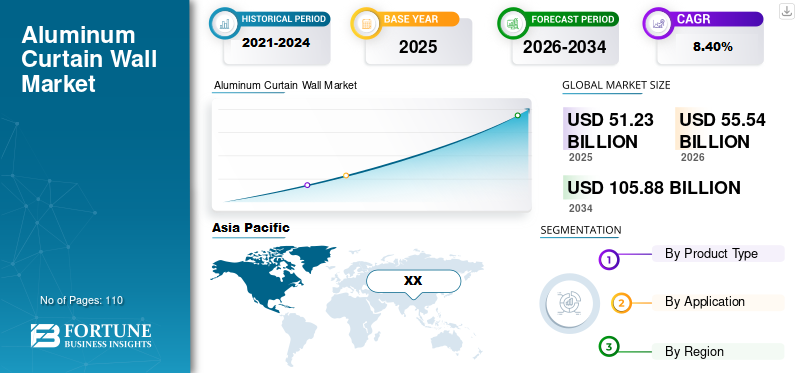
Aluminum Curtain Wall Market Overview Analysis By Fortune Business Insights
Market Size & Forecast
According to Fortune Business Insights: The global aluminum curtain wall market was valued at USD 51.23 billion in 2025 and is projected to grow from USD 55.54 billion in 2026 to USD 105.88 billion by 2034, at a compound annual growth rate (CAGR) of 8.40% during the forecast period. Asia Pacific led all regions with a dominant 44.02% market share in 2025, fueled by robust construction activity across China, India, and Japan. In the United States alone, the market is projected to reach USD 9.41 billion by 2027, driven by expanding commercial construction and growing adoption of energy-efficient façade systems.
What Is an Aluminum Curtain Wall?
An aluminum curtain wall (ACW) is a non-structural exterior cladding system consisting of horizontal and vertical structural components — known as transoms and mullions — attached to a building's frame. The system is engineered to withstand predefined wind loads, safely transferring forces through the building's structure. It is composed of key elements including vision glass, mullions, transoms, and anchors, and functions as both a buffer and insulator, keeping air and rain outside while improving thermal efficiency and structural stability, particularly in tall buildings.
Get a Sample Research PDF: https://www.fortunebusinessinsights.com/enquiry/request-sample-pdf/102782
Key Market Drivers
Multiple Functional Advantages of ACW: Aluminum curtain walls offer a compelling combination of performance benefits — thermal insulation, UV ray restriction, excellent sound attenuation, and impact resistance. By moderating indoor temperatures, ACW systems reduce dependence on air conditioning, lowering overall building operating costs. In taller structures, they also help reduce sway by diffusing kinetic forces through the frame, enhancing overall structural safety.
Sustainability of Aluminum: Aluminum's inherent eco-friendly properties make it a preferred material for modern, green-conscious construction. Its high strength-to-weight ratio, design flexibility, long service life, high reflectivity, and fire safety characteristics contribute to building sustainability. Importantly, aluminum is highly recyclable — in the United Kingdom, over 99% of aluminum frames are recovered from construction waste. Each ton of recycled aluminum can offset more than 9 tons of CO₂ equivalent emissions, and theoretically, aluminum building components can be recycled for over 3,000 years.
Construction Growth in Developing Economies: Rapid urbanization and industrialization in emerging markets, particularly China and India, are creating highly conducive conditions for ACW demand. India's government-backed Smart Cities Mission — launched in June 2015 — is accelerating infrastructure modernization across selected cities, directly boosting demand for advanced façade solutions. India is also projected to become the world's third-largest construction market, further underpinning long-term market expansion.
Investment in Aluminum Extrusion Capacity: Leading aluminum extrusion companies are actively expanding production capacity to meet growing construction demand. Strategic investments in high-capacity extrusion presses — such as HAI Extrusion Germany's USD 15 million investment in a 3,300-ton press in 2018 — are strengthening the supply chain and improving the availability of high-quality aluminum profiles for curtain wall systems.
Restraining Factors
High Installation and Maintenance Costs represent the primary challenge for market growth. Transporting and storing curtain wall panels involves significant expense, and the installation process requires highly skilled labor, pushing up total project costs. Periodic maintenance is essential to preserve aesthetic quality, including sealant replacement over time. Anodized aluminum frames demand careful cleaning as harsh detergents can damage the coating surface. Additionally, adverse weather conditions can delay on-site installation, adding further costs related to manpower and temporary storage.
Market Segmentation
By Product Type: The market is divided into unitized, stick-built, and other systems. The unitized curtain wall segment dominates, as its factory-manufactured, interlocking panel design enables installation in roughly one-third the time required for stick-built systems, while delivering superior quality control. Stick-built systems — where components are installed sequentially on-site — hold a meaningful share of approximately 37.4%, owing to their flexibility in custom applications and refurbishment projects.
By Application: Commercial buildings command the largest revenue share, driven by stringent government regulations requiring reduced greenhouse gas emissions from large structures. ACW systems effectively reduce the thermal load on HVAC systems, supporting regulatory compliance while also enhancing the visual appeal and security of commercial properties. The residential segment is growing steadily as modern architectural design increasingly incorporates façade glazing in urban housing developments.
Regional Analysis
Asia-Pacific leads globally, with China and India together accounting for the largest share of the global construction market. Bulk aluminum availability and government-driven urbanization initiatives underpin strong regional demand.
Europe ranks second, with Germany holding the highest revenue share, supported by a strong manufacturing base and increasing investment in advanced, sustainable façade systems. The United Kingdom is the region's second-largest consumer.
North America holds the third-largest share, growing at a CAGR of 6.7%, with the U.S. being the world's second-largest construction market and a major curtain wall consumer. Canada is also showing notable growth, with non-residential construction investment rising 4.9% year-on-year.
Latin America, Middle East & Africa together hold a smaller but growing share, supported by rising public and private investment in commercial and residential infrastructure development.
Connect with Our Expert for any Queries: https://www.fortunebusinessinsights.com/enquiry/speak-to-analyst/102782
Key Industry Players
Leading companies shaping the global aluminum curtain wall market include Schüco International KG (Germany), ALUMIL S.A. (Greece), Kawneer Company Inc. (U.S.), Reynaers Aluminium (Belgium), ALUTECH, EFCO Corporation (U.S.), TECHNAL, HUECK System GmbH & Co. KG (Germany), ETEM Group, HansenGroup Limited, and Qingdao Longxiang Building Materials Co., Ltd. (China).
Conclusion
The global aluminum curtain wall market is poised for strong, sustained growth through 2034, propelled by rapid urbanization, rising demand for energy-efficient and sustainable building solutions, and increasing construction investment across both developed and emerging economies. While high installation and maintenance costs remain a restraint, the material's unmatched sustainability credentials and functional versatility position aluminum curtain walls as a cornerstone technology in the future of modern architecture.


Comments