
Event Tourism Market Size, Experiential Travel Trends and Global Growth Forecast 2026–2034
- Ajit Kumar
- 15 hours ago
- 4 min read

Event Tourism Market Overview Analysis By Fortune Business Insights
Introduction
Event tourism is the practice of traveling to a destination primarily to attend or participate in specific events — from business conferences and trade exhibitions to music festivals, sporting competitions, and cultural fairs. Beyond traditional sightseeing, it offers travelers immersive and transformative experiences, allowing meaningful engagement with local cultures and communities. This sector has evolved into one of the most dynamic segments of the global tourism industry, driven by shifting traveler preferences and rapid technological advancement.
Market Size & Growth Outlook
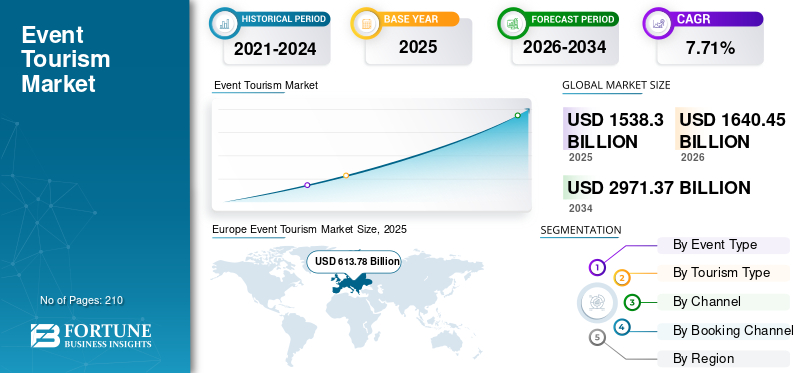
According to Fortune Business Insights: The global event tourism market was valued at USD 1,538.30 billion in 2025 and is projected to grow from USD 1,640.45 billion in 2026 to USD 2,971.37 billion by 2034, reflecting a compound annual growth rate (CAGR) of approximately 7.71–7.86% over the forecast period (2026–2034). This robust trajectory underscores the growing appetite for experiential travel and the global expansion of event infrastructure.
Get a Sample Research PDF: https://www.fortunebusinessinsights.com/enquiry/request-sample-pdf/113369
Key Market Segments
By Event Type Sports tourism commands the largest share — approximately 41% in 2024 and projected at 38.59% in 2026 — driven by global passion for events such as the Olympics, FIFA World Cup, and Formula One. Music tourism is the fastest-growing segment, fueled by rising global concert culture and the launch of regional music shows targeting new audience bases.
By Tourism Type Domestic tourism leads with a projected 65.02% share in 2026, owing to fewer barriers such as no visa requirements and shorter travel distances. International tourism is the faster-growing category, with a CAGR of 8.56%, propelled by globally rotating mega-events like the World Cup and international music festivals.
By Channel Physical events dominate with a 71.66% share in 2026, as attendees value live atmospheres, networking, and cultural immersion. Virtual participation, holding a 28% share in 2025, is growing rapidly — particularly among younger, tech-savvy generations attracted by AI-driven recommendations and flexible content access.
By Booking Channel Online booking leads at 60.11% of the market in 2026, offering round-the-clock convenience and bundled travel packages. Offline booking is seeing a resurgence for complex, high-value events where personalized service is preferred.
Regional Highlights
Europe is the dominant region, holding 39.90% of the global market in 2025 (USD 613.78 billion), growing to USD 650.93 billion in 2026. Its rich cultural heritage, strong infrastructure, and early adoption of hybrid event formats across the U.K., Germany, France, and Italy solidify its leadership.
North America is the second-largest region at USD 442.11 billion in 2025 (28.74% share). World-class infrastructure, advanced event technology, and a well-established tradition of hosting high-profile corporate, sports, and entertainment events keep the U.S. at the forefront globally.
Asia Pacific accounted for USD 325.2 billion in 2025 (21.14% share), with China and India as the primary growth engines. India is emerging as a global MICE hub through government initiatives like Incredible India and the development of Bharat Mandapam. China is expanding its exhibition infrastructure while supporting large-scale expos.
Middle East & Africa held 4.47% of the global market in 2025 (USD 68.76 billion). Dubai and Abu Dhabi are rapidly positioning themselves as premier destinations through strategic investment in infrastructure and global event hosting.
Market Drivers & Trends
The market is propelled by surging demand for unique, personalized event experiences — particularly from millennials and Gen Z who seek authenticity and cultural connection. The MICE (Meetings, Incentives, Conferences, and Exhibitions) sector is a critical driver, as multinational expansion increases demand for cross-border professional gatherings. Direct spending on global events rose sharply from USD 525 million in 2021 to USD 938 million in 2022 — a nearly 44% increase in one year.
Social media platforms have transformed event discovery and promotion, with Instagram, TikTok, and influencer collaborations turning local events into international attractions. Customized travel packages — such as those launched by MakeMyTrip for European destinations — are also gaining strong traction.
Challenges & Restraints
High costs of premium event packages remain a significant barrier, limiting accessibility for middle- and lower-income travelers. In emerging regions, inadequate infrastructure — including insufficient venues, transportation, and supporting amenities — restricts the scale and type of events that can be hosted, curbing growth potential.
Connect with Our Expert for any Queries: https://www.fortunebusinessinsights.com/enquiry/speak-to-analyst/113369
Competitive Landscape
Key players include Expedia Group Inc., Trip.com Group Ltd., TUI AG, Accor S.A., Amex GBT, Lufthansa Group, Hilton Worldwide Holdings, and Marriott International. Leading companies are increasingly forming strategic partnerships with artists, brands, governments, and sponsors to host large-scale events and diversify revenue. Sustainability is also gaining ground, with players like Expedia Group launching green destination programs in 2024 to attract environmentally conscious travelers.
Conclusion
The global event tourism market is on a strong and sustained growth path, expected to nearly double in value by 2034. Driven by experiential demand, MICE expansion, digital convenience, and regional investment, the sector presents vast opportunities for stakeholders across travel, hospitality, technology, and event management. Addressing cost barriers and infrastructure gaps in emerging markets will be essential to unlocking the market's full potential.


Comments