
Flood Barrier Market Size, Share, Trends, Growth and Forecast 2026–2034
- Ajit Kumar
- 38 minutes ago
- 5 min read

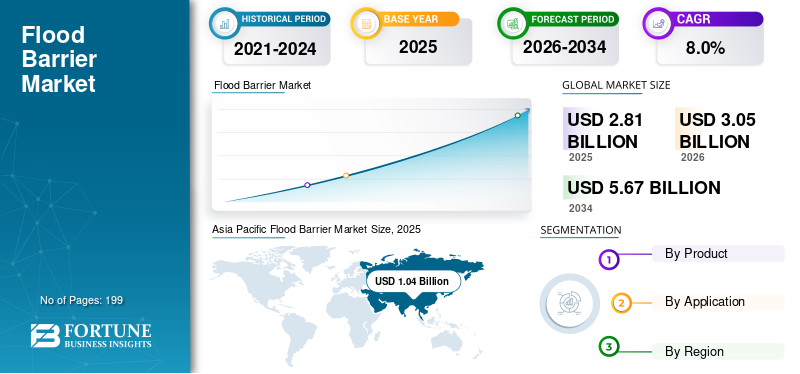
Flood Barrier Market Overview Analysis By Fortune Business Insights
Market Summary
According to Fortune Business Insights: The global flood barrier market was valued at USD 2.81 billion in 2025 and is projected to grow from USD 3.05 billion in 2026 to USD 5.67 billion by 2034, exhibiting a CAGR of 8.0% during the forecast period. A flood barrier refers to a constructed physical element or configured system designed to stop or redirect the flow of water to protect flooded areas — deployed in permanent, temporary, or automated forms across protection scales ranging from individual properties to entire coastal zones. The market is expanding due to the rising frequency and severity of floods driven by climate change, accelerating urbanization and infrastructure development, rising sea levels affecting coastal zones, stricter government regulations, and technological advances in resilient infrastructure. Asia Pacific dominated the global market with a 37.10% share in 2025, valued at USD 1.04 billion.
Get a Sample Research PDF: https://www.fortunebusinessinsights.com/enquiry/request-sample-pdf/114732
Key Market Drivers
The rising frequency and severity of floods — primarily driven by climate change, erratic weather conditions, and high urbanization — is the primary market driver. Governments, municipalities, and private sector organizations are intensifying investments in robust flood management infrastructure to protect critical assets and populations. Growing awareness of disaster preparedness, regulatory policies mandating flood risk mitigation, and the increasing economic cost of flood damage are collectively driving cities toward adopting superior flood barrier solutions to reduce disaster recovery expenses and support sustainable urban development.
The integration of smart monitoring technologies, predictive flood modeling, and data-driven maintenance programs is the defining market trend. Increasing investment in resilient flood infrastructure is being supported by global climate resilience frameworks, with modular and permanent barrier systems becoming strategic priorities for governments and private entities. International climate adaptation funds are promoting cooperative projects that enable rapid adoption of advanced flood mitigation technologies across both developed and emerging markets, broadening the commercial opportunity for barrier manufacturers and system integrators.
Market Restraints and Challenges
High upfront costs and deployment complexity are the primary market restraints. Substantial start-up and installation expenditure, combined with the technical difficulty of system implementation, frequently discourages small-scale users and municipalities with limited budgets. Lengthy regulatory approval processes, requirements for integration with existing drainage systems, regular maintenance obligations, and the need for specialized workforces further complicate deployment. These challenges make cost optimization, modular design innovation, and streamlined permitting essential prerequisites for driving broader adoption across both developing and developed markets.
Market Opportunities
Urban retrofit programs and the growing demand for temporary flood protection solutions represent the most significant near-term market opportunity. Rapidly urbanizing regions are driving demand for scalable, cost-effective barriers that can provide short-term protection during seasonal flooding without requiring permanent structural modifications. Temporary and modular barriers are emerging as viable alternatives to permanent infrastructure — particularly for cities, event organizers, and commercial property owners requiring flexible, on-demand protection. Manufacturers are capitalizing on this trend through product innovation, value-added services including installation and maintenance contracts, and public-private collaboration models linked to smart city and climate adaptation programs.
Segmentation Analysis
By product, the permanent barriers segment is projected to dominate with a 38.36% share in 2026, driven by government and municipal investment in long-term flood defense infrastructure to protect urban areas and critical assets. High preference for durable, low-maintenance solutions where land-use planning and long capital planning horizons justify higher upfront expenditure reinforces the segment's leadership. Temporary barriers are projected to grow at the highest CAGR of 8.8%, reflecting their rapid deployment flexibility, lower initial cost, and rising adoption by cities and event organizers that require scalable, on-demand protection without permanent structural changes.
By application, the urban segment is projected to dominate with a 36.07% share in 2026, as densely populated coastal and riverine cities prioritize flood protection to safeguard lives, property, and critical infrastructure. High economic value of urban assets and stricter building and planning regulations drive large investments in both permanent and hybrid solutions. The urban segment also holds the highest application CAGR of 8.8%, driven by accelerating urbanization, greater extreme weather exposure, and growing municipal budget allocation for climate resilience. Municipal retrofits, waterfront redevelopment, and integrated city planning are creating recurring demand for innovative flood barrier systems. River, coastal, transportation, and utility and critical infrastructure segments contribute significant incremental demand, particularly as sea-level rise accelerates coastal protection requirements globally.
Regional Outlook
Asia Pacific leads the market at USD 1.04 billion in 2025 (37.10% share), projected at USD 1.15 billion in 2026 and expected to register the fastest regional CAGR of 9.6% through 2034. The region's leadership reflects its large population in low-lying coastal zones, high exposure to monsoons and typhoons, and major infrastructure investment programs. China is projected at USD 0.43 billion in 2026, India at USD 0.21 billion, and Japan at USD 0.19 billion — each supported by national and local government funding for large-scale flood defense. Europe was valued at USD 0.71 billion in 2025 (25.10% share), projected at USD 0.75 billion in 2026, supported by rising investment in flood control measures and climate resilience driven by extreme weather events. Germany leads the region at USD 0.18 billion in 2026, followed by the U.K. at USD 0.13 billion and Italy at USD 0.08 billion. North America contributed USD 0.58 billion in 2025 (20.60% share), projected at USD 0.62 billion in 2026, with the U.S. at USD 0.45 billion in 2026 — driven by increasing extreme weather events, rising insurance costs, and a strong focus on resilient coastal and urban infrastructure. The Middle East and Africa reached USD 0.28 billion in 2025 (10.10% share), projected at USD 0.31 billion in 2026, supported by climate change-related floods, rapid urbanization, and government infrastructure and disaster mitigation initiatives, with GCC countries at USD 0.12 billion in 2025. Latin America contributed USD 0.20 billion in 2025 (7.10% share), projected at USD 0.22 billion in 2026.
Connect with Our Expert for any Queries: https://www.fortunebusinessinsights.com/enquiry/speak-to-analyst/114732
Competitive Landscape
The global flood barrier market features key players focused on R&D investment to develop innovative, lightweight, and rapidly deployable barrier systems. Companies are expanding manufacturing capabilities, pursuing geographic expansion and customization, and emphasizing barrier effectiveness, durability, cost-efficiency, and environmental impact in increasingly design-sensitive urban environments. Key players include AquaFence (Norway), AWMA Water Control Solutions (Australia), Blobel Umwelttechnik (Germany), Denilco Environmental Technology (China), Flood Control International (U.K.), FloodBreak LLC (U.S.), IBS Technics GmbH (Germany), Muscle Wall (U.S.), NoFloods (Denmark), PS Industries (U.S.), The Flood Company (U.S.), and US Flood Control Corporation (U.S.). In September 2025, Flood Risk America launched its Passive Automatic Flood Gate — a self-activating barrier that deploys automatically when floodwaters rise, providing dependable automated flood protection. In January 2023, the Flex Seal Family of Products launched Flex Seal Flood Protection, a new line of four products specially formulated to defend homes and businesses from floodwaters while remaining fully removable after waters recede.
Curious About Japan’s Market? Explore the Latest - Flood Barrier Market Insights


Comments