
Green Methanol Market Size, Share, Trends, Growth and Forecast 2026–2034

Green Methanol Market Overview Analysis By Fortune Business Insights
Market Summary
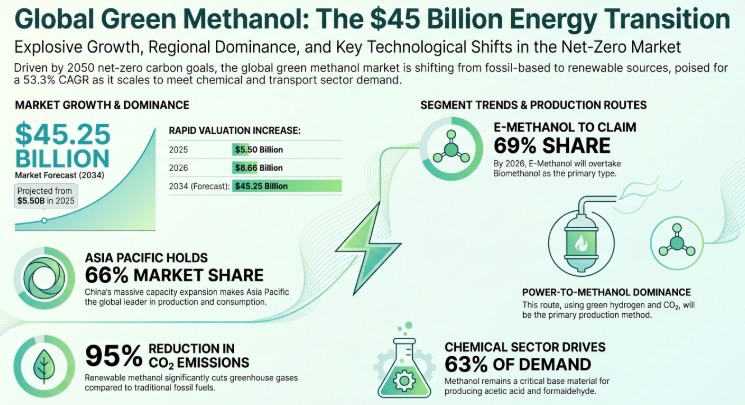
According to Fortune Business Insights: The global green methanol market was valued at USD 5.50 billion in 2025 and is projected to grow from USD 8.66 billion in 2026 to USD 45.25 billion by 2034, at a CAGR of 53.3% during the forecast period. Green methanol — produced from biomass feedstocks (biomethanol) or synthesized from green hydrogen and captured carbon dioxide (e-methanol) — is emerging as a critical enabler of decarbonization across the chemical, marine, road transport, and aviation sectors. The life-cycle emissions of conventional methanol account for approximately 0.3 gigatons of CO2 per year — around 10% of total chemical sector emissions — but using sustainable feedstocks including biomass, waste, CO2, and green hydrogen can reduce these emissions by up to 95% or even achieve a fully carbon-neutral product. Asia Pacific dominated the market with a 66.00% share in 2025, valued at USD 3.63 billion.
Get a Sample Research PDF: https://www.fortunebusinessinsights.com/enquiry/request-sample-pdf/106875
Key Market Drivers
Government initiatives and supportive policy frameworks are the primary market driver. Renewable methanol can reduce up to 95% of CO2 emissions, 80% of nitrogen oxide emissions, and 100% of particulate matter emissions relative to conventional fuels, making it a compelling decarbonization option for sectors — such as maritime shipping, chemical feedstock production, and road transport — where low-emission alternatives have historically been limited. Governments globally have responded with favorable policies: China has mandated methanol blending in gasoline across multiple provinces at concentrations ranging from 5% to 100% over the past decade. Israel introduced an M15 fuel blend (85% gasoline, 15% methanol) capable of 2% CO2 reduction. Egypt, India, Italy, New Zealand, and other nations are actively evaluating methanol-gasoline blend strategies to reduce carbon footprints while maintaining vehicle performance. These coordinated global policy signals are structurally accelerating capacity investment and market adoption.
Momentum toward sustainability and the circular economy is a defining market trend. The imperative to limit global temperature rise to no more than 1.5°C by 2050 requires net carbon neutrality across all industrial sectors, and green methanol — producible from bio-feedstocks and green hydrogen — is gaining rapid attention from both investors and established conventional methanol producers seeking to futureproof their asset bases. Green methanol also carries a significant operational advantage: it can be used directly as a fuel without requiring modifications to existing vehicle engines, positioning it as a drop-in decarbonization solution across multiple transport modes.
Market Restraints and Challenges
High production costs are the most significant restraint on market growth. Feedstock costs for biomass and municipal solid waste (MSW) range from USD 0 to USD 17 per gigajoule (GJ), while biomass costs alone span from approximately USD 320 to USD 770 per metric ton — a wide deviation that introduces meaningful uncertainty in project economics. The current low-scale production of green hydrogen further compounds production cost challenges, as hydrogen is the primary raw material in the power-to-methanol route. The combination of high and variable feedstock costs, capital-intensive conversion infrastructure, and limited economies of scale is restraining near-term market expansion, though targeted policy support and technology improvement are expected to erode these barriers progressively toward 2030 and beyond.
Segmentation Analysis
By type, the biomethanol segment held the largest global market share in 2023, driven by its established production infrastructure, lower cost compared to e-methanol, and accessible feedstocks — including forestry and agricultural residues, landfill biogas, sewage gas, and municipal solid waste. The e-methanol segment is expected to achieve the dominant market share of 69.05% by 2026, reflecting the strong commercial and policy-driven pivot toward zero-carbon, hydrogen-based methanol produced via renewable electricity, electrolysis, and direct air capture or point-source CO2. According to the IEA, the transportation sector alone accounted for over one-third of global carbon emissions in 2021, creating substantial demand for e-methanol's drop-in, carbon-neutral fuel profile.
By production route, the power-to-methanol segment is projected to account for 69.05% of the global market by 2026, driven by its capacity expansion momentum and key technical advantages — green hydrogen from water electrolysis burns cleanly, and CO2 can be sourced from carbon capture systems or directly from the air. The biomethane reforming route held a significant share in 2023, valued for its relatively straightforward production pathway — converting biogas into syngas and then into biomethanol — and the wide availability and ease of access to biogas feedstock as a co-feed alongside natural gas reforming infrastructure.
By end use, the chemical segment is expected to account for the majority share of 63.28% in 2026, underpinned by methanol's role as a fundamental base material for a wide range of chemical compounds including acetic acid and formaldehyde, and its expanding use in the production of ethylene and propylene. The fuel segment is growing substantially, driven by green methanol's carbon-neutral credentials, its utility as an energy carrier storable at room temperature with an indefinite shelf life, and its growing adoption as a marine fuel — particularly following IMO greenhouse gas reduction mandates — and potential deployment across road, air, and off-road transport.
Regional Outlook
Asia Pacific leads the global market at USD 3.63 billion in 2025, accounting for 66.00% of global revenues, and is projected to reach USD 5.86 billion in 2026. China — already the world's largest conventional methanol producer and consumer — is set to account for over 90% of regional green methanol production and consumption, with its market projected at USD 4.88 billion in 2026. Japan is projected at USD 0.32 billion and India at USD 0.09 billion in 2026, each supported by national energy transition policies and growing industrial demand. Europe generated USD 1.0 billion in 2025, representing 18.10% of global revenues, and is expected to reach USD 1.85 billion in 2026, driven by decarbonization mandates, the EU's transport sector — which contributes nearly 5% of total EU GDP — and strong industrial demand in Germany (projected at USD 0.43 billion in 2026) and the U.K. (USD 0.14 billion). North America contributed USD 0.82 billion in 2025 (14.90% global share), projected to grow to USD 0.89 billion in 2026, with the U.S. market reaching USD 0.85 billion on the back of new capacity investment plans and domestic demand from chemical and alternative fuel sectors. The Rest of the World — including Brazil, Mexico, Saudi Arabia, and Egypt — contributed USD 0.06 billion in 2025 and is advancing moderately as policy frameworks and investment pipelines develop.
Connect with Our Expert for any Queries: https://www.fortunebusinessinsights.com/enquiry/speak-to-analyst/106875
Competitive Landscape
The global green methanol market is in a nascent but rapidly developing stage, with market players aggressively pursuing capacity expansion to capitalize on first-mover advantages. Key players profiled include Alberta-Pacific Forest Industries Inc. (Canada), ANDRITZ (Austria), Avaada Group (India), Cepsa (Spain), Enerkem (Canada), Mitsui & Co. Ltd. (Japan), OCI Global (Netherlands), SunGas Renewables (U.S.), Thyssenkrupp Uhde GmbH (Germany), and Veolia (France). In January 2024, BASF and Envision Energy announced a collaboration to develop advanced processes for converting green hydrogen and CO2 into e-methanol. In December 2023, Cepsa and C2X jointly committed over USD 1 billion to a new green methanol plant targeting shipping, aviation, chemical, and other sectors. In September 2023, OCI Global announced plans to double its U.S. green methanol production capacity to 400 kilotons. In July 2023, A.P. Moller–Maersk-backed SunGas Renewables announced plans for a USD 2 billion, 400-kiloton green methanol plant in Louisiana, U.S., targeted for production by 2027.
Curious About Japan’s Market? Explore the Latest - Green Methanol Market - Insights


Comments