
Automotive Catalytic Converter Market Size, Share, Trends, Growth and Forecast 2026–2034

Automotive Catalytic Converter Market Overview Analysis By Fortune Business Insights Analysis
Market Summary
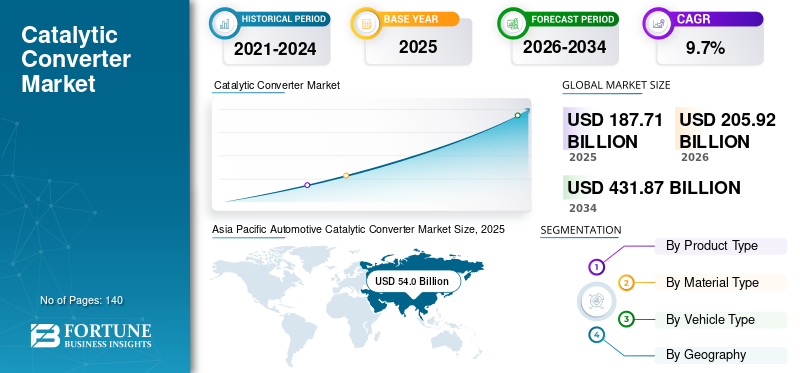
According to Fortune Business Insights: The global automotive catalytic converter market was valued at USD 187.71 billion in 2025 and is projected to grow from USD 205.92 billion in 2026 to USD 431.87 billion by 2034, exhibiting a CAGR of 9.70% during the forecast period. Catalytic converters eliminate harmful exhaust gases, including nitrogen oxide, carbon monoxide, and hydrocarbons, through chemical redox reactions that convert them into nitrogen, oxygen, carbon dioxide, and water. These devices play a central role in improving vehicle efficiency and enabling compliance with increasingly strict emission regulations worldwide. Asia Pacific dominated the market with a 73.17% share in 2025, led by strong automotive manufacturing growth in China, India, and Japan.
Get a Sample Research PDF: https://www.fortunebusinessinsights.com/enquiry/request-sample-pdf/102046
Key Market Trends
Nanotechnology advancement is reshaping converter design, with platinum nanoparticles combined with titanium dioxide nanofibers used to increase catalyst effectiveness. Mazda launched the first nano-particle catalytic converter in 2007, and subsequent industry adoption has continued to build on this approach, improving conversion efficiency while reducing the amount of precious metal required per unit.
Key Market Drivers
Stricter emission standards are a primary growth driver, with the implementation of Bharat Stage VI in India, Euro VI in Europe, and China VI in China all mandating converter integration across new vehicles. Increased vehicle production, fueled by rising urbanization and growing disposable income, continues to expand the overall addressable market for converters. Broader environmental regulations and government policies promoting emission control devices and fuel efficiency are reinforcing this growth across both developed and developing automotive markets.
Market Restraints
Vehicle electrification represents the most significant restraint on the market, as electric vehicles eliminate the need for catalytic converters and traditional exhaust systems altogether. As EV adoption accelerates globally, this structural shift is expected to gradually limit long-term demand for converter technology in passenger vehicle segments, even as internal combustion engine vehicles remain dominant in the near term.
Segmentation Analysis
By product type, three-way oxidation-reduction converters (TWORCC) form the dominant segment, performing three simultaneous chemical conversions, while two-way oxidation converters (TWOCC) offer a more basic combination of reduction and oxidation catalysts; diesel oxidation catalysts (DOC) are used exclusively in diesel engines and are projected to see steady growth. By material type, rhodium dominates as the primary reduction catalyst given its strong overall demand across the automotive industry, while palladium held an 18.2% share in 2025 as an oxidation catalyst favored for its thermal stability and lower cost, and platinum serves dual roles across both reduction and oxidation functions. By vehicle type, passenger cars represent the largest segment at USD 34.01 billion in 2025, driven primarily by gasoline engines that require TWORCC systems; light commercial vehicles are a growing segment with rising diesel engine adoption, while heavy commercial vehicles are expected to see exponential growth as diesel engines increasingly utilize DOC and SCR technologies.
Connect with Our Expert for any Queries: https://www.fortunebusinessinsights.com/enquiry/speak-to-analyst/102046
Regional Outlook
Asia Pacific led the market with a 73.17% share in 2025, with China, India, and Japan driving the bulk of regional growth through expanding automotive manufacturing and tightening emission regulations; Japan alone was valued at USD 3.92 billion in 2025, supported by advanced manufacturing capabilities and strict environmental standards. Europe held the second-largest share, underpinned by Euro VI emission standards and a robust automotive manufacturing base across the region. North America represented an emerging growth market, with expanding vehicle production and stringent U.S. regulations supporting continued converter adoption alongside the broader shift toward China VI-equivalent standards in other regions.
Competitive Landscape
BASF Catalysts LLC leads the market as the company that pioneered the automotive catalytic converter in 1970, followed by HJS Emission Technology GmbH & Co. KG, Tenneco Inc., Marelli Holdings Co., Ltd., FUTABA INDUSTRIAL CO., LTD., Benteler International AG, Eberspächer, Bosal, Sango Co., Ltd., and Standard Motor Products Europe Ltd. In November 2017, Faurecia developed an electrically heated catalytic converter, which debuted in 2019 and improved cold-start and idle efficiency. In January 2017, Tenneco invested Rs 50 crore in its Sanand plant in India to manufacture exhaust systems, reflecting continued investment in regional manufacturing capacity to meet rising demand. Market opportunities remain concentrated in emerging markets with growing vehicle production, the development of advanced emission control technologies, aftermarket replacement demand, and sustained hybrid vehicle demand during the broader transition toward electrification.
What Everyone Should Know About Japan’s Market Automotive Catalytic Converter Market Insights
Comments