
Dining Table Market Size, Share, Trends, Growth and Forecast 2026–2034

Dining Table Market Overview Analysis By Fortune Business Insights Analysis
Market Summary
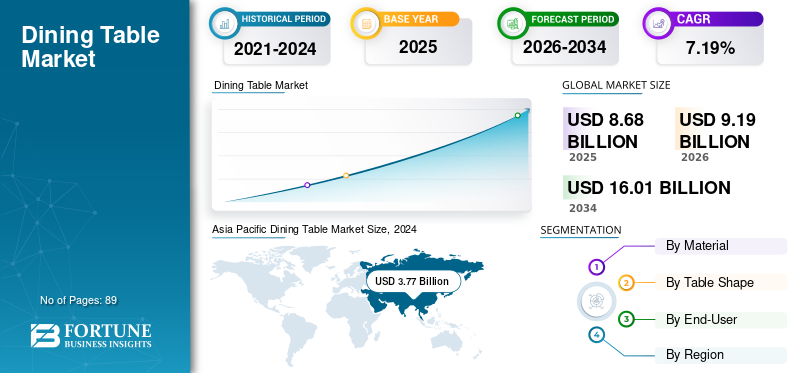
According to Fortune Business Insights: The global dining table market was valued at USD 8.68 billion in 2025 and is projected to grow from USD 9.19 billion in 2026 to USD 16.01 billion by 2034, exhibiting a CAGR of 7.19% during the forecast period. Growth is being driven by evolving home décor preferences, rising demand for furniture quality, rapid urbanization, and growing disposable incomes. Dining tables are also increasingly being used for multifunctional purposes, serving as both dining and workspace furniture in modern households. Asia Pacific led the market with a 46.14% share in 2025, underpinned by strong demand across the region's residential and commercial sectors.
Get a Sample Research PDF: https://www.fortunebusinessinsights.com/enquiry/request-sample-pdf/106138
Key Market Trends
Manufacturers are placing greater emphasis on sustainable materials, including recycled wood, recycled plastic, and eco-friendly finishes, in response to rising environmental awareness among consumers. There is also growing preference for luxury, customizable designs built around minimalistic aesthetics. E-commerce presence continues to expand, with retailers increasingly using AR and 3D visualization tools to help customers shop for dining furniture online. Demand for multifunctional tables that serve dual purposes, supporting both dining and remote-work needs, continues to rise as well.
Key Market Drivers
Home renovation and decoration trends are a significant driver, with roughly 30% of homeowners prioritizing surface upgrades such as dining furniture. Infrastructural expansion in the hospitality sector is also fueling demand, exemplified by China's 9.17 million restaurants as of 2021. Luxury furniture demand has grown notably, with MillerKnoll reporting a 74.3% sales increase in its Q2–Q3 2022 period. The continued adoption of remote work has increased the need for multifunctional household furniture, while the expansion of restaurants, cafés, and commercial dining facilities is further supporting market growth.
Market Restraints
Skin irritation caused by chemical-based finishes on certain products remains a concern for some consumers. Counterfeit furniture produced by unorganized manufacturers continues to undercut established brands and affect overall market quality perceptions. Fluctuating raw material costs add further pressure on manufacturer margins, and the retail and hospitality sectors still bear some lingering effects from COVID-19 lockdown disruptions.
Segmentation Analysis
By material, wood held a 52.77% share in 2026, dominating the market due to its natural aesthetics and engineered durability, while metal sees significant demand in corporate canteens and restaurants, plastic is growing through recycled plastic-based options, and other materials such as glass, leather, and fabric are gaining traction. By table shape, rectangular tables led with a 54.73% share in 2026, favored for their diverse size options and extendability, while round tables are gaining popularity as space-saving solutions, square tables are seeing rising demand among nuclear families and rented apartments, and oval tables are expanding on growing consumer awareness. By end-user, the residential segment held a 55.28% share in 2026, driven by higher consumption of multifunctional, compact designs, while the commercial segment is growing through restaurant, office, and public canteen facilities.
Connect with Our Expert for any Queries: https://www.fortunebusinessinsights.com/enquiry/speak-to-analyst/106138
Regional Outlook
Asia Pacific led the market with a 46.14% share in 2025 (USD 4.0 billion, projected at USD 4.27 billion in 2026), reflecting the region's dominant position. North America followed with a 25.35% share (USD 2.2 billion in 2025, USD 2.33 billion projected for 2026), with the U.S. segment expected to reach USD 2.34 billion by 2032. Europe held a 19.28% share (USD 1.67 billion in 2025, USD 1.74 billion projected for 2026), with demand concentrated in extendable and ceramic-top tables. South America accounted for a 4.77% share (USD 0.41 billion in 2025, USD 0.43 billion projected for 2026), supported by an outdoor dining trend in Brazil and Chile, while the Middle East & Africa held a 4.46% share (USD 0.39 billion in 2025, USD 0.41 billion projected for 2026), with notable demand for plastic-based tables in South Africa.
Competitive Landscape
Key players in the market include Steelcase Inc. (U.S.), MillerKnoll, Inc. (U.S.), Ashley Furniture Industries, Inc. (U.S.), Global Furniture USA (U.S.), KOKUYO Co., Ltd. (Japan), Ethan Allen Global, Inc. (U.S.), Godrej & Boyce Mfg. Co. Ltd. (India), B&B ITALIA SPA (Italy), Sunpan Trading & Importing, Inc. (Canada), and CB2 (U.S.). In June 2023, WOUD showcased its new Ludo dining table and Soma dining chair designs. In May 2023, Transformer Table launched an extendable patio dining set across 35 countries. In February 2023, Steelcase collaborated with the Frank Lloyd Wright Foundation on its Racine Collection, and Yashika Luthra Designs opened a 4,000 sq. ft. showroom in Delhi that same February. In July 2021, IMM Private Equity invested USD 1.3 billion to acquire Hanssem Co. of South Korea, and in March 2021, Plüsch launched a luxury table range made from natural stone, wood, glass, and metal in Germany.
Curious About Japan’s Market? Explore the Latest Dining Table Market Insights
Comments